
BobQuasit (e)k Blish(r)en Devils Day liburuaren kritika egin du
A dark, powerful novel of philosophical supernatural horror in the near future
5 izar
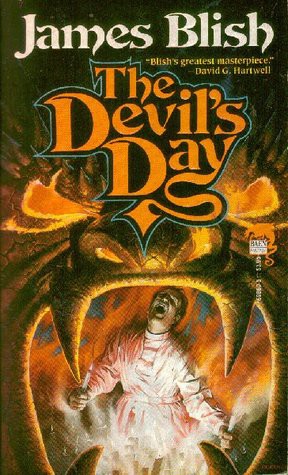
If a darker book doesn't bother you, you might like James Blish's novel "The Devil's Day".
The book was originally broken into two novels and published separately as "Black Easter" (1968) and "The Day After Judgement" (1971). They were unified and published as "The Devil's Day" in 1980.
The genre is unusual, in that it's supernatural horror/fantasy/philosophy with a dash of science fiction. In the near future (more or less), an international arms merchant finds himself bored with his profession. So he locates a black magician and commissions him to release all the demons of Hell onto the Earth for one night, with no restrictions, just to see what they do.
Needless to say things don't go •quite• as expected!
This is NOT standard fantasy, however. Blish researched actual medieval grimoires for the book, and treats the subject seriously. In other words, as if the black magic of the Middle …
If a darker book doesn't bother you, you might like James Blish's novel "The Devil's Day".
The book was originally broken into two novels and published separately as "Black Easter" (1968) and "The Day After Judgement" (1971). They were unified and published as "The Devil's Day" in 1980.
The genre is unusual, in that it's supernatural horror/fantasy/philosophy with a dash of science fiction. In the near future (more or less), an international arms merchant finds himself bored with his profession. So he locates a black magician and commissions him to release all the demons of Hell onto the Earth for one night, with no restrictions, just to see what they do.
Needless to say things don't go •quite• as expected!
This is NOT standard fantasy, however. Blish researched actual medieval grimoires for the book, and treats the subject seriously. In other words, as if the black magic of the Middle Ages actually worked the way that the grimoires of the time described it. I'm not aware of any other modern book which takes the same approach. It makes magic much more frightening and morally weighted, since ANY use of magic must be assumed to result in the eternal damnation of the soul of the magician. In other words, this is quite the serious book—with a few brief moments of levity.
I think it's safe to say that this is not a book for children or even many young adults. Although I'm pretty sure I read it in my late teens. No doubt some things went over my head a bit at the time.
Sadly the entire book (i.e. "The Devil's Day") isn't available on the Internet Archive at all. "Black Easter" is (and it can definitely be read on its own), but "The Day After Judgement" isn't! So all I can do is suggest you try "Black Easter" online and then see if your library can get the whole thing for you. Or buy it. Or 🏴☠️ it.
Here's the IA link to borrow "Black Easter": archive.org/details/blackeasterorfau0000blis
Incidentally, "The Devil's Day" is part of a thematic trilogy that Blish called "After Such Knowledge". The other two books are in no way connected to each other or "The Devil's Day", except in that they both address the same religio-philosophical issue of secular knowledge and Evil.
"Doctor Mirabilis" (1964) is a purely historical novel about the 13th century Franciscan monk Roger Bacon and his attempt to develop a Universal Science.
In "A Case of Conscience" (1958) a monk encounters an alien species that appears to be free of original sin, which leads him to a trial for heresy. It's pure science fiction.
These are all powerful, mature works from one of the finest minds of the golden age of science fiction.
Happy reading! 🤓📖