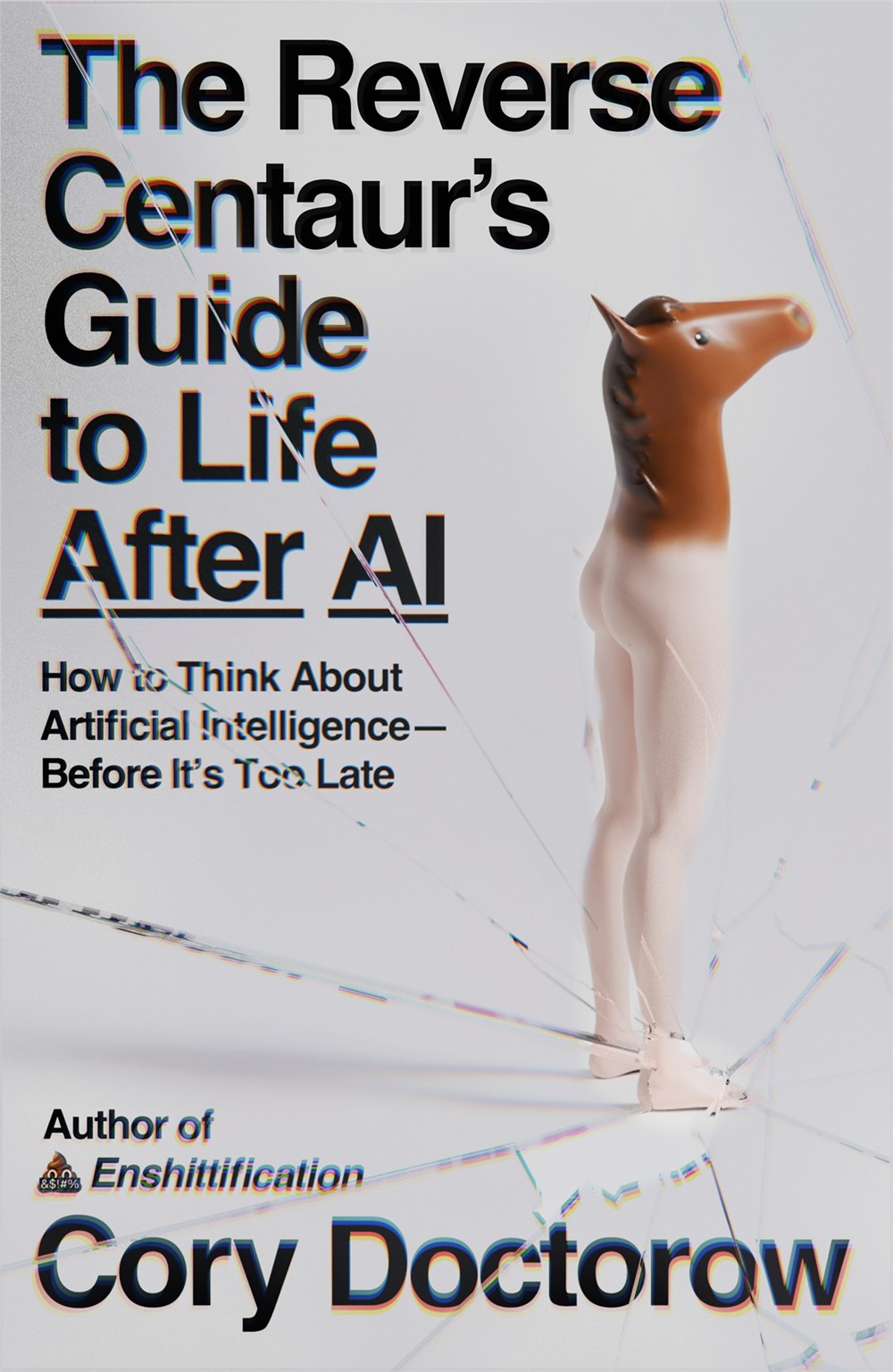
A centaur is a person whose work is assisted by technology, a worker whose tools make them happier and more productive. A reverse centaur, on the other hand, is a worker pressed into service to technology, a person pushed beyond human endurance to work on a machine’s terms. Think of a warehouse worker made to work without food or bathroom breaks, or a programmer made to crank out impossible amounts of code.
There is, to Cory Doctorow, nothing inevitable about the story of AI, about who or what will play which roles. He thinks the technology is useful, even exciting. But AI has arrived surrounded by unprecedented hype, preordained as a world-changing disruption that defies all rational evaluation. Doctorow seeks to puncture that bubble before it’s too late, to help us understand the technology not just for what it actually does—though that, of course, is important—but who it does it …
A centaur is a person whose work is assisted by technology, a worker whose tools make them happier and more productive. A reverse centaur, on the other hand, is a worker pressed into service to technology, a person pushed beyond human endurance to work on a machine’s terms. Think of a warehouse worker made to work without food or bathroom breaks, or a programmer made to crank out impossible amounts of code.
There is, to Cory Doctorow, nothing inevitable about the story of AI, about who or what will play which roles. He thinks the technology is useful, even exciting. But AI has arrived surrounded by unprecedented hype, preordained as a world-changing disruption that defies all rational evaluation. Doctorow seeks to puncture that bubble before it’s too late, to help us understand the technology not just for what it actually does—though that, of course, is important—but who it does it to and who it does it for.
From that point of view, the story of AI is indeed dramatic and unprecedented, though it is not the version of the story we have been commonly told. In The Reverse Centaur’s Guide to Life After AI—as he did so successfully in Enshittification—Doctorow recounts both how we found ourselves in this situation and how we can get through it, to a life “after” AI in which the tools work for us, not the other way around.
doctorow is a bit too much of a techno-optimist for me to get fully onboard with, and the "what remains after the bubble" section is too pro-ai for my liking. as a seasoned follower of zitron there isn't anything too surprising in this book as far as the criticisms of ai are concerned. probably a good one for people who are less terminally online i.e. a bit further removed from the coal face of ai, or those who have a less critical disposition towards ai. a good one to share with your tech coworkers.