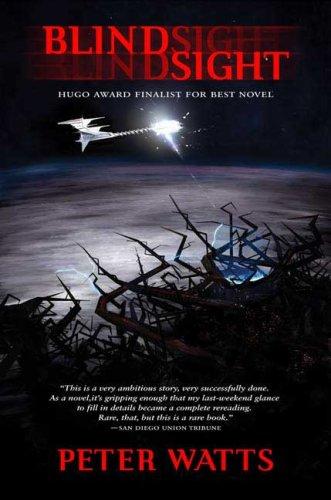
Two months since sixty-five thousand alien objects clenched around the Earth like a luminous fist, screaming to the heavens as the atmosphere burned them to ash. Two months since that moment of brief, bright surveillance by agents unknown.
Two months of silence while a world holds its breath.
Now some half-derelict space probe, sparking fitfully past Neptune's orbit, hears a whisper from the edge of the solar system: a faint signal sweeping the cosmos like a lighthouse beam. Whatever's out there isn't talking to us. It's talking to some distant star, perhaps. Or perhaps to something closer, something en route.
So who do you send to force introductions on an intelligence with motives unknown, maybe unknowable? Who do you send to meet the alien when the alien doesn't want to meet?
You send a linguist with multiple personalities, her brain surgically partitioned into separate, …
Two months since the stars fell...
Two months since sixty-five thousand alien objects clenched around the Earth like a luminous fist, screaming to the heavens as the atmosphere burned them to ash. Two months since that moment of brief, bright surveillance by agents unknown.
Two months of silence while a world holds its breath.
Now some half-derelict space probe, sparking fitfully past Neptune's orbit, hears a whisper from the edge of the solar system: a faint signal sweeping the cosmos like a lighthouse beam. Whatever's out there isn't talking to us. It's talking to some distant star, perhaps. Or perhaps to something closer, something en route.
So who do you send to force introductions on an intelligence with motives unknown, maybe unknowable? Who do you send to meet the alien when the alien doesn't want to meet?
You send a linguist with multiple personalities, her brain surgically partitioned into separate, sentient processing cores. You send a biologist so radically interfaced with machinery that he sees X-rays and tastes ultrasound, so compromised by grafts and splices that he no longer feels his own flesh. You send a pacifist warrior in the faint hope she won't be needed, and a fainter hope that she'll do any good if she is needed. You send a monster to command them all, an extinct hominid predator once called "vampire," recalled from the grave with the voodoo of recombinant genetics and the blood of sociopaths. And you send a synthesist—an informational topologist with half his mind gone—as an interface between here and there, a conduit through which the Dead Center might hope to understand the Bleeding Edge.
You send them all to the edge of interstellar space, praying you can trust such freaks and retrofits with the fate of a world. You fear they may be more alien than the thing they've been sent to find.
But you'd give anything for that to be true, if you only knew what was waiting for them....
If you like Vandermeer's Southern Reach, but wish it were a little (just) less fantastical, you'll love this. Watts throws lots of ideas at you, all supported by extensive references and citations. Well worth the read
The uncertainty of first contact, amid the uncertainty of human contact.
4 izar
Edukiari buruzko abisua
Mildly spoilery review, no details
I have only just encountered Watts's work. This book is a crashing tangle of ideas, drawing from evolutionary biology, to (most particularly) cognitive science and philosophy of mind of the late 1990s.
A ship, whose crew are all variously transhuman in diverse ways, are sent to communicate with first contact. The newcomers, however, are deeply mysterious, alien in the realest sense. The result a disorienting experience in which none of the available main characters are quite someone you can wholly empathise with, and we remain uncertain throughout of just what the encounter will involve for the crew or humanity generally.
My perception overall is this book, with its extensive references and sources section, is the kind of thing you might get if Michael Crichton wrote space opera (though perhaps more disciplined and sharper). It is jam packed with well executed ideas. Ultimately, I found it quite difficult to get through in parts simply because of just how utterly out of their depth everyone was, and how desperate and hopeless the contact mission would seem to be. I suspect this is indeed Watts's intent.
While it was nice to see the richness of the cognitive science being drawn on, my own theoretical commitments also mean that none of what is in play with regards to human cognition is really tenable though. That's a very niche complaint that most of the world won't have. A little more broadly is the easiness of the some of the evolutionary psychology though - some of which is I think a little problematic.
Overall, though, this is a very solid, well written space opera thriller, if a little grim.
Probably the most mind-blowing book I've read this year. Difficult to untangle, but riveting and suspenseful. I hope Watts continues this thought experiment on intelligence and consciousness and new ways of thinking about thinking.